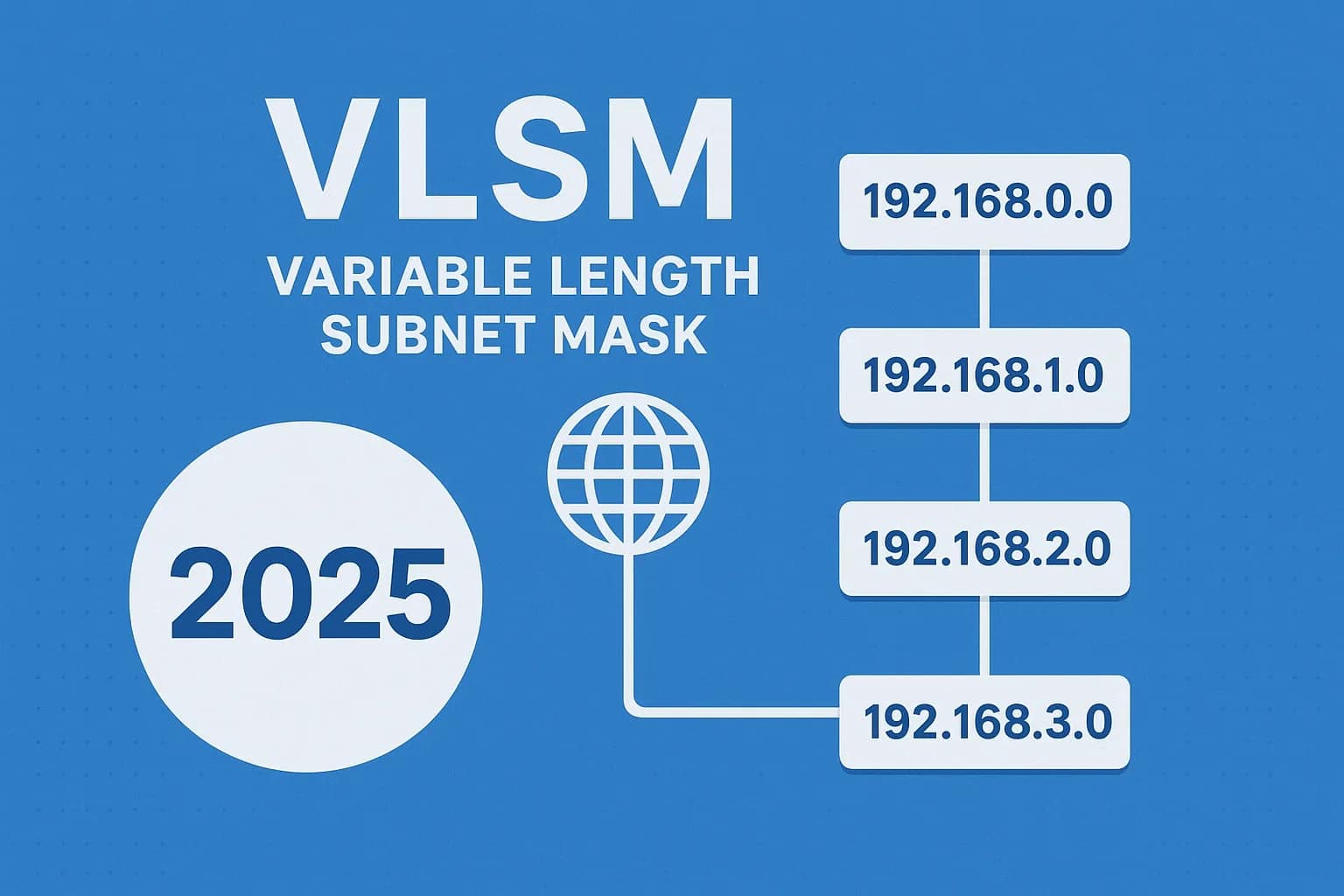
VLSM (Variable Length Subnet Mask) – Complete Guide 2025


Introduction to VLSM
VLSM (Variable Length Subnet Mask) 2025
In modern computer networking, efficient use of IP addresses is extremely important. With the rapid growth of networks, cloud computing, IoT, and enterprise infrastructures, wasting IP addresses is no longer acceptable. This is where VLSM (Variable Length Subnet Mask) plays a crucial role.
VLSM allows a network administrator to divide an IP network into subnets of different sizes, based on actual requirements. Unlike traditional subnetting, where all subnets are of equal size, VLSM provides flexibility, efficiency, and scalability.
In 2025, VLSM is widely used in:
- Enterprise networks
- ISP routing
- Cloud and data center networking
- CCNA, CCNP, and other certification exams
- Real-world routing protocols like OSPF, EIGRP, and BGP
What is VLSM?
VLSM (Variable Length Subnet Mask) 2025VLSM (Variable Length Subnet Mask)
is a technique used in IP networking that allows the use of different subnet masks within the same network.
Definition
VLSM is the process of subnetting a network multiple times using subnet masks of different lengths, based on host requirements.
Key Idea
- One large network is broken into unequal-sized subnets
- Each subnet gets only the number of IP addresses it actually needs
- Reduces IP address wastage
Why VLSM Was Introduced
VLSM (Variable Length Subnet Mask) 2025
Before VLSM, networks used Classful Addressing and Fixed Length Subnet Masking (FLSM).
Problems with FLSM
- All subnets must be the same size
- Large IP wastage
- Not scalable
- Inefficient for real-world networks
Solution
VLSM was introduced to:
- Optimize IP usage
- Support hierarchical network design
- Enable classless routing
VLSM vs FLSM
VLSM (Variable Length Subnet Mask) 2025
| Feature | FLSM | VLSM |
|---|---|---|
| Subnet size | Same for all | Different sizes |
| IP usage | Wastes IPs | Efficient |
| Flexibility | Low | High |
| Routing protocols | Limited | Advanced |
| Real-world use | Rare | Very common |
Classful vs Classless Addressing
VLSM (Variable Length Subnet Mask) 2025
Classful Addressing
- Class A, B, C
- Fixed subnet masks
- No flexibility
Classless Addressing (CIDR & VLSM)
VLSM (Variable Length Subnet Mask) 2025
- Any subnet mask length
- Efficient routing
- Supports modern protocols
VLSM works only with classless routing protocols.


Routing Protocols That Support VLSM
VLSM requires routers to share subnet mask information.
Supports VLSM
✔ RIPv2
✔ OSPF
✔ EIGRP
✔ IS-IS
✔ BGP
Does NOT Support VLSM
✘ RIPv1
✘ IGRP
Understanding Subnet Masks in VLSM
Subnet masks define:
- Network portion
- Host portion
Example:
/24→ 255.255.255.0/26→ 255.255.255.192/30→ 255.255.255.252
In VLSM, different subnets use different masks:
- LAN →
/24 - Small LAN →
/27 - Point-to-Point link →
/30
Benefits of VLSM
1. Efficient IP Address Usage
Only required IPs are allocated.
2. Better Network Design
Hierarchical and structured addressing.
3. Reduced Routing Table Size
Summarization is easier.
4. Scalability
Easy to expand networks.
5. Essential for Modern Networking
Cloud, WAN, ISP designs rely on VLSM.
Basic Rules of VLSM
- Start with the largest subnet requirement
- Assign addresses in descending order
- Never overlap subnets
- Use proper subnet boundaries
- Always reserve:
- Network address
- Broadcast address
VLSM Calculation – Step-by-Step
Example Network
Given network:
192.168.10.0/24
Requirements:
- Network A → 100 hosts
- Network B → 50 hosts
- Network C → 25 hosts
- Point-to-Point link → 2 hosts
Step 1: Sort by Host Requirement
| Network | Hosts Needed |
|---|---|
| A | 100 |
| B | 50 |
| C | 25 |
| D | 2 |
Step 2: Find Required Subnet Masks
| Hosts | Subnet | Usable Hosts |
|---|---|---|
| 100 | /25 | 126 |
| 50 | /26 | 62 |
| 25 | /27 | 30 |
| 2 | /30 | 2 |
Step 3: Assign Subnets
Network A
- Network: 192.168.10.0/25
- Usable: 192.168.10.1 – 192.168.10.126
- Broadcast: 192.168.10.127
Network B

- Network: 192.168.10.128/26
- Usable: 192.168.10.129 – 192.168.10.190
- Broadcast: 192.168.10.191
Network C
- Network: 192.168.10.192/27
- Usable: 192.168.10.193 – 192.168.10.222
- Broadcast: 192.168.10.223
Point-to-Point
- Network: 192.168.10.224/30
- Usable: 192.168.10.225 – 192.168.10.226
- Broadcast: 192.168.10.227
VLSM in Real-World Networks
Enterprise Network
- HR LAN → /26
- Finance LAN → /27
- Servers → /28
- Router links → /30
ISP Network
- Customer blocks → /29, /28
- Backbone links → /30 or /31
Data Centers
- Different subnet sizes for:
- Management
- Storage
- VM networks
VLSM with Point-to-Point Links
For router-to-router connections:
- Use
/30(traditional) - Use
/31(modern, RFC 3021)
Benefits:
- Saves IPs
- Efficient WAN usage
VLSM and CIDR
VLSM works together with CIDR (Classless Inter-Domain Routing).
Example:
- 10.0.0.0/8 → broken into:
- 10.1.0.0/16
- 10.1.1.0/24
- 10.1.1.128/25
CIDR allows route summarization, VLSM allows subnet flexibility.
Common VLSM Mistakes
❌ Starting with small subnets
❌ Overlapping IP ranges
❌ Forgetting broadcast address
❌ Using RIPv1
❌ Incorrect subnet boundary
VLSM in Cisco Exams (2025)
VLSM is very important for:
- CCNA
- CCNP
- Network interviews
Expected skills:
- Subnet calculation
- Design scenarios
- Troubleshooting IP conflicts
VLSM Interview Questions
- What is VLSM?
- Difference between VLSM and FLSM?
- Why does RIPv1 not support VLSM?
- Design a network using VLSM
- What subnet mask supports 30 hosts?
Advantages and Disadvantages
Advantages
✔ Saves IP addresses
✔ Flexible design
✔ Scalable
✔ Industry standard
Disadvantages
✘ More complex than FLSM
✘ Requires planning
✘ Needs classless routing
VLSM Best Practices (2025)
- Always document IP plans
- Use IPAM tools
- Start from largest subnet
- Reserve future growth
- Use
/31where possible - Enable route summarization
VLSM in IPv6 Context
While IPv6 has abundant addresses, VLSM concepts still apply:
- Prefix length planning
- Efficient allocation
- Hierarchical design
Conclusion
In 2025, VLSM is no longer optional—it is a fundamental networking skill. Whether you are:
- A student
- A network engineer
- A DevOps professional
- Preparing for CCNA/CCNP
- Designing enterprise networks
Understanding VLSM helps you:

- Save IP addresses
- Design scalable networks
- Improve routing efficiency
- Work confidently in real-world scenarios
Mastering VLSM means mastering modern IP networking.
If you want, I can also provide:
- ✅ VLSM solved problems
please subscribe my website lilke and share others to click here
example
| host | network | Block size | |
| /25 | 126 | 2 | 128 |
| /26 | 62 | 4 | 64 |
| /27 | 30 | 8 | 32 |
| /28 | 14 | 16 | 16 |
| /29 | 6 | 32 | 8 |
| /30 | 2 | 64 | 4 |
VLSM is responsible to make optimal use of ip address
According to our scenario we require 5+10+15+25+45=100 host & 2+2=4 address for serial interface total ip address is 104 so we can use class c itself.
³ net A -> require only 5 host check table host column -> 6 with /29 so use 192 168 10.0/29
³ net B -> require only 10 host check table host column -> 14 with /28 so ip will start from check previous network (net A) blog of /29 is 8 add that with ip so ip will be 192 168 10.8/28
³ net C -> require only 15 host check table host column -> 30 with /27 so ip will start from check previous network (net B) blog of /28 is 16 add that with ip so ip will be 192 168 10.24/27
³so on for other network … … … … … … … .